Two-dimensional porous carbon supports promote molecular diffusion for efficient semihydrogenation of 2-methyl-3-butyn-2-ol
Abstract
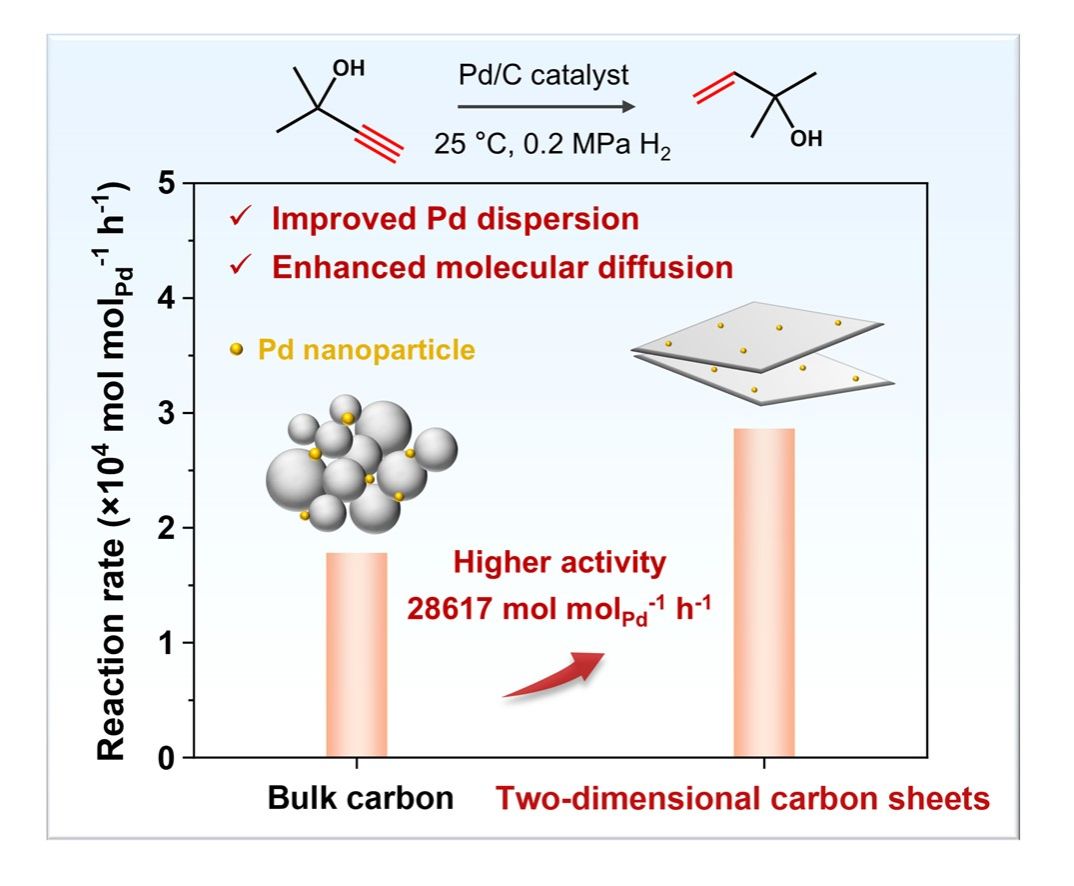
The selective hydrogenation of alkynols to alkenols is an industrially important route to fine chemicals, yet competing over-hydrogenation pathways make it challenging to maintain alkenol selectivity at high conversion. Herein, we report an ultrathin two-dimensional porous carbon support with a thickness of 13 nm and an aspect ratio of up to 615. Compared with conventional bulk carbon supports, this two-dimensional architecture provides a larger externally accessible surface area, thereby promoting Pd dispersion and facilitating liquid-phase molecular diffusion. The resulting Pd catalyst achieves an exceptional reaction rate of 28617 mol molPd−1 h−1 for the semihydrogenation of 2-methyl-3-butyn-2-ol under mild conditions (298 K, 0.2 MPa H2), representing a 31-fold enhancement relative to the commercial Lindlar catalyst, while maintaining 93% selectivity at 99% conversion. Moreover, the catalyst exhibits good stability over five consecutive cycles, with no detectable Pd agglomeration or leaching. This work highlights dimension control of carbon supports as an effective strategy to enhance external surface accessibility, offering new insights into the design of high-performance semihydrogenation catalysts.



