Heterogeneous boron-based catalysts for small molecules upgrading to high-value-added chemicals
Abstract
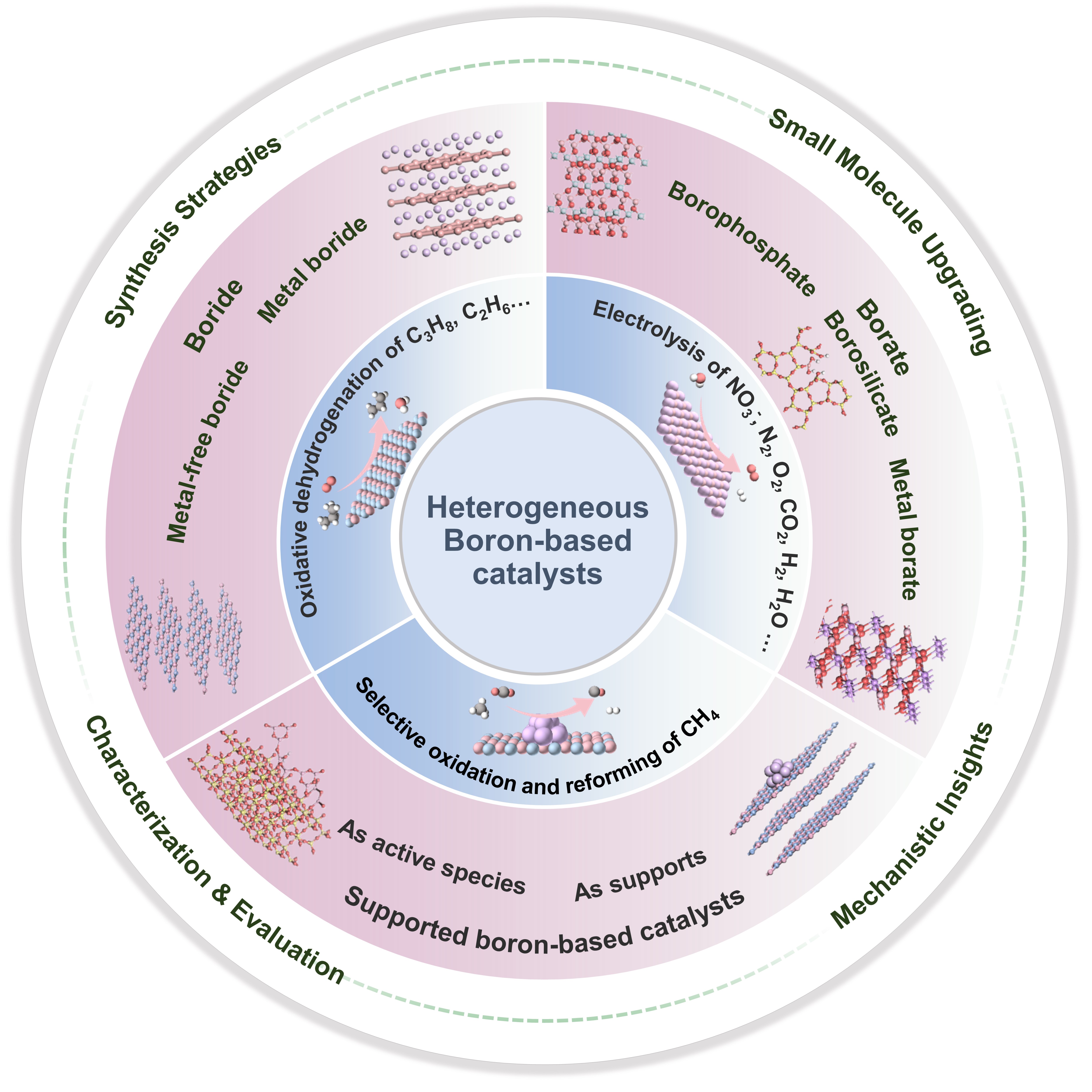
Heterogeneous boron-based catalysts represent a distinct class of materials for small molecule upgrading, providing catalytic functions complementary to those of conventional metal-based systems. The structural versatility of boron-containing compounds governs their performance in a range of reactions. A prominent case is the oxidative dehydrogenation of propane, where boron-based systems routinely achieve propylene selectivity in excess of 80% at 20% propane conversion, a regime wherein conventional metal oxide benchmarks are typically limited to selectivity below 60%. Though still in their developmental infancy, heterogeneous boron-based catalysts present an immense potential for industrial applications. This review surveys progress in the preparation of both bulk and supported boron-based catalysts and critically examines their mechanistic roles in small molecule upgrading. Specific emphasis is placed on the selective oxidation of methane, dry and steam reforming of methane to syngas, oxidative dehydrogenation of light alkanes and ethylbenzene, and emerging applications in electrocatalysis. Beyond summarizing recent progress, we address rational design strategies, key characterization techniques, and approaches for reliable performance evaluation. Available evidence indicates that boron species can participate directly in surface reactions, modify metal or support interfaces, stabilize working phases, and influence the formation and propagation of gas-phase radicals. The relative importance of these functions depends on the catalyst structure and reaction conditions. By linking observed catalytic behavior to underlying surface chemistry, this analysis provides a structured perspective to guide future research on heterogeneous boron-based catalysis.



