Data driven rational design of carboxylate ester co-solvents for high-rate sodium-ion battery electrolyte
Abstract
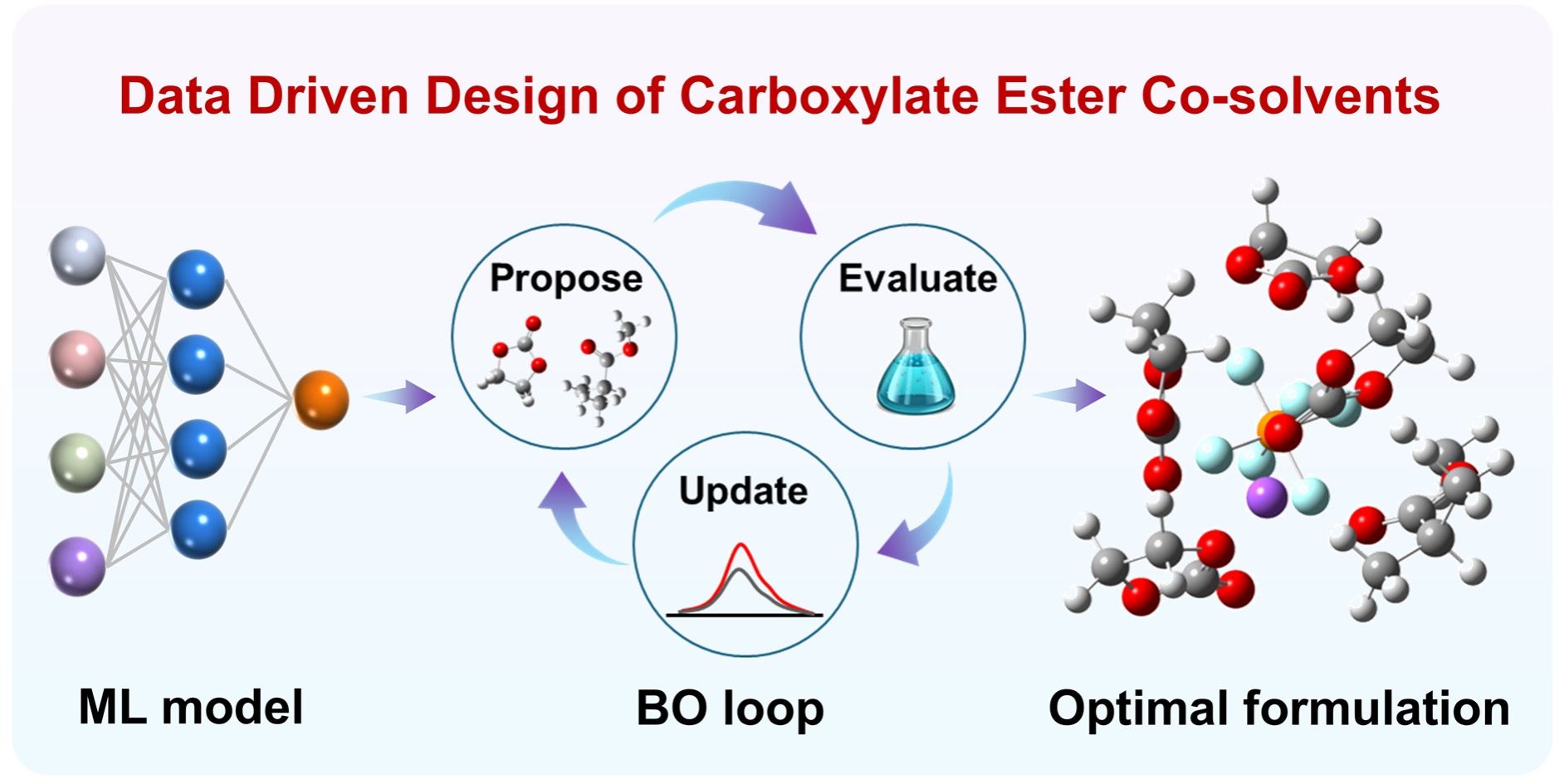
Electrolyte engineering is fundamental to the advancement of sodium-ion batteries (SIBs), with co-solvent design emerging as a particularly critical lever for optimizing Na⁺ solvation structure, desolvation kinetics, and solid electrolyte interphase (SEI) formation. However, traditional trial-and-error screening is inappropriate to this complexity, hindering the rational discovery of optimal formulations. Here, we establish a data-driven framework for the discovery and optimization of carboxylate ester co-solvents in Ethylene carbonate (EC)-based SIB electrolytes by integrating interpretable machine learning and Bayesian optimization. Model interpretation identifies key molecular descriptors, including Wiener index, Lowest Unoccupied Molecular Orbital (LUMO) energy and melting point, that provide effective guidance for co-solvent selection. Notably, the LUMO energy directly governs the susceptibility of the α-hydrogen site in carboxylate esters toward reductive decomposition. Guided by this framework, methyl isobutyrate (MiB) is identified as the optimal co-solvent, and an EC/MiB volume ratio of 55:45 is determined as the optimal formulation. The optimal electrolyte reduces the Na⁺ desolvation barrier and enables a gradient interphase comprising an inorganic inner layer and an organic outer layer. In Na||hard carbon half cells, it delivers 239.7 mAh g-1 at 0.2 A g-1 (84.25% retention relative to 0.02 A g-1) and 143.9 mAh g-1 at 0.5 A g-1 (50.59% retention). When further supplemented with 3 wt% fluoroethylene carbonate (FEC), NaFePO4||hard carbon full cells achieve 93.42% capacity retention after 100 cycles at 0.1 A g-1. This work provides an effective data-driven strategy for electrolyte optimization toward fast-charging SIBs.



